

The hardest thing a successful company can do is change how it operates when it's still winning.
Ben Horowitz described peacetime and wartime as different modes of leadership more than a decade ago. It remains one of the most useful frameworks for understanding how leaders need to think and act differently in each environment. What it doesn’t fully address is the cultural dimension. Even when leaders understand the shift is required, the organizational culture, its decision-making patterns, structures, and incentives, often determine whether the shift is successful.
In peacetime, a company is focused on maximizing their current opportunity. They have a clear advantage in their core market. The operating mode is straightforward: extend the existing lead while allocating capital and resources towards a series of initiatives that don’t deviate from the tried and true playbook to incrementally improve the existing product to ensure all the competitive boxes are checked. Strategic decisions are focused on a narrow defined set of outcomes to generate modest and predictable growth. The organization is built to protect what’s working, not to reinvent it..
In wartime, everything is different. Growth is slowing, the competitive dynamics have shifted dramatically around the company, and the moves that produced predictable gains in peacetime are no longer enough to keep up. There is no tried and true playbook. The incremental improvements that defended the lead in peacetime will not be enough to stay competitive. Capital and resources are constrained and require tough tradeoff decisions where the right answers are not completely clear. Decisions that used to take months need to happen in days. And the methodical consensus-driven culture that built the organization no longer works.
The shift from one mode to the other is where most companies break down.
This isn’t a new problem. I watched it play out at Yahoo two decades ago. It didn’t end well. And you can see versions of it playing out across many companies and industries today.
Yahoo! Won Peacetime. It Never Figured Out Wartime.
I was at Yahoo! in the early 2000s. The company was one of the earliest, most useful gateways to the web when the internet was still hard to navigate. Its human-curated directory made the chaotic early web feel organized, and it quickly expanded into email, news, sports, finance, shopping, and messaging, so users could do many things in one place. It was the center of the consumer internet. It was dominant. It was supposed to be what Google turned out to be.
As late as 2005, Yahoo remained the dominant force on the consumer internet with 6.2 billion monthly visits compared to Google’s 2.9 billion. It had massive brand recognition, unmatched distribution, and category-leading services in mail, finance, news, and sports. On paper it looked unbeatable.
But by 2006 the internet playing field had changed. Consumers were quickly shifting toward single-purpose services in search, social, video, and others that did one thing exceptionally well. The very advantage Yahoo had built, doing everything, became its biggest liability.
Wartime had arrived. And Yahoo was never able to make the shift. Looking back, three things went wrong.
Focus
Yahoo never answered the most important question a company can face: what kind of company are we? Were they a technology company or a media company?
At the time, Yahoo’s mission was to be “a leading provider of comprehensive online products and services to consumers and businesses worldwide.” That mission gave everyone in the company permission to do everything. And at Yahoo, they tried. Email, news, sports, finance, search, entertainment, shopping, wireless, and more. There was no filter for what mattered most and no basis for saying no.
Google’s mission was the opposite: “organize the world’s information and make it universally accessible and useful.” You could walk into any product meeting at Google and ask “does this make information more accessible?” and get a clear answer. At Yahoo the same question had no answer because the mission didn’t draw any lines.
Google didn’t try to be everything. It obsessed over one thing: making search faster, more relevant, and more comprehensive. While Yahoo’s homepage grew busier and its strategy broader, Google’s stayed brutally simple: a white page with a box. Its PageRank algorithm got smarter as the web grew. More pages, more links, better results. Google treated search as an engineering problem, not a content or media one.
The identity confusion ran deeper. Yahoo insisted on calling itself a media company while operating like a technology company. Product managers were called “Producers.” Divisions were called “Properties.” But the product was software. And if you think you’re a media company, you invest in content and advertising, not engineering. Yahoo tried to do both. It never resolved the tension between them. Resources were split and neither the content nor the technology side ever got the full commitment it needed. Google, which never confused itself for anything other than a technology company, pulled ahead.
Without a clear identity there can be no focus. And without focus every strategic decision becomes a debate about what Yahoo is rather than what it should do next. In peacetime Yahoo could afford to be everything to everyone. When wartime arrived and Google became the front door to the internet, YouTube became the destination for video and Facebook became the gateway to people’s social lives, Yahoo was still trying to be everything. Everyone else was winning at one thing.
Decisiveness
When you don’t know what you are, you can’t make hard calls. Yahoo had multiple moments where a single decision could have shifted the outcome. In 1998 Yahoo passed on buying Google for $1 million. In 2006 Yahoo tried to acquire Facebook. The deal fell apart. That same year Yahoo was in talks to acquire YouTube. Google moved faster, and won the deal.
Yahoo’s peacetime culture became a trap. With many peacetime cultures, the hardest decisions just stop as the organization confuses alignment with 100% consensus. Brad Garlinghouse, a senior Yahoo executive who later became CEO of Ripple, captured this accurately in the Peanut Butter Manifesto, an internal memo that became public in 2006. He wrote that Yahoo was held hostage by analysis paralysis. Decisions were either not made or made too late. I watched this firsthand. I remember an executive around the same time sharing his frustrations that decision making at Yahoo was similar to an andon cord on a manufacturing line. Anyone could pull it and stop a project cold. In theory it was designed to maintain quality. In practice it meant no significant project ever shipped because everyone, regardless of their role or proximity to the decision, had veto power and nobody had clear ownership.
Unable to make timely decisions, Yahoo kept reacting to the competition instead of setting their own agenda. By the end of 2005, just sixteen months after Google went public, Google was worth more than twice Yahoo’s market value. The window to act had closed.
Culture and Organizational Design
At Yahoo, the operating by committee culture drowned out the best ideas. By the 2005 timeframe, product decisions were increasingly made by committee rather than by the product managers and engineers closest to the problem. The best ideas got watered down through rounds of reviews and sign-offs, so what shipped barely resembled what was proposed. It was the opposite of single-threaded ownership. Project Panama, Yahoo’s effort to rebuild its search advertising platform and close the gap with Google, was the clearest proof. The project was more than a year late. Decisions required sign-off from committee after committee. Engineering chiefs were hired and gone in rapid succession. By the time Panama launched in 2007, Google had used the time to extend its lead to the point where Yahoo could no longer close the gap.
Yahoo had extraordinary talent. The problem was the organizational operating system they were asked to work within. The people who wanted to solve hard problems, move fast and build things left to join startups, Google, or start their own companies. Some of the most famous examples: Jan Koum and Brian Acton left in 2007 and built WhatsApp, which Facebook acquired for $19 billion. Paul Graham left to co-found Y Combinator, which went on to launch Airbnb, Dropbox, and Stripe. Many other Yahoo alumni went on to start many other successful companies including Slack, Cloudera, SurveyMonkey, and MyFitnessPal, to name a few.
Yahoo saw the threat. It just couldn’t become the kind of company that could fight it.
OpenAI: A Modern Version of the Same Story
OpenAI’s parallels to Yahoo are hard to ignore. ChatGPT was the fastest product in history to reach 100 million users. By 2024, OpenAI defined the category. It had the most recognized brand in AI, the deepest enterprise relationships, and a developer ecosystem that anchored most of the industry’s tooling. On paper, it looked unbeatable. The company spent much of 2024 and 2025 placing bets across video generation, hardware, social media, e-commerce, and enterprise software simultaneously.
In March 2026, OpenAI’s CEO of applications told staff the company had to stop being distracted and “nail” its core business. OpenAI’s leadership has named the problem out loud, which Yahoo’s never quite did. Whether they can do the harder thing, focus on rebuilding their core business, is still being written.
What Wartime Leadership Actually Looks Like
The best example of a leader and company that successfully made the cultural shift from peacetime to wartime was Steve Jobs when he returned to Apple in 1997.
At the time the company was weeks from bankruptcy. Apple was operating with no clear strategy or purpose as few employees could say with confidence what Apple stood for or what success was supposed to look like. As a result, the organization veered into trying to serve too many customer types at once, with a confusing lineup of Macs and side projects. In addition to the muddled Mac product line, the company launched the infamous Apple Newton and licensed the Mac operating system to clone makers in an attempt to grow market share, which cannibalized its own hardware margins and muddied its product identity. The “do everything” approach created confusion among customers, developers, and employees alike.
Jobs saw the problems clearly and moved fast. He focused on three things: a clear strategy, unleashing innovation through simplification, and building accountability into the organization to drive flawless execution.
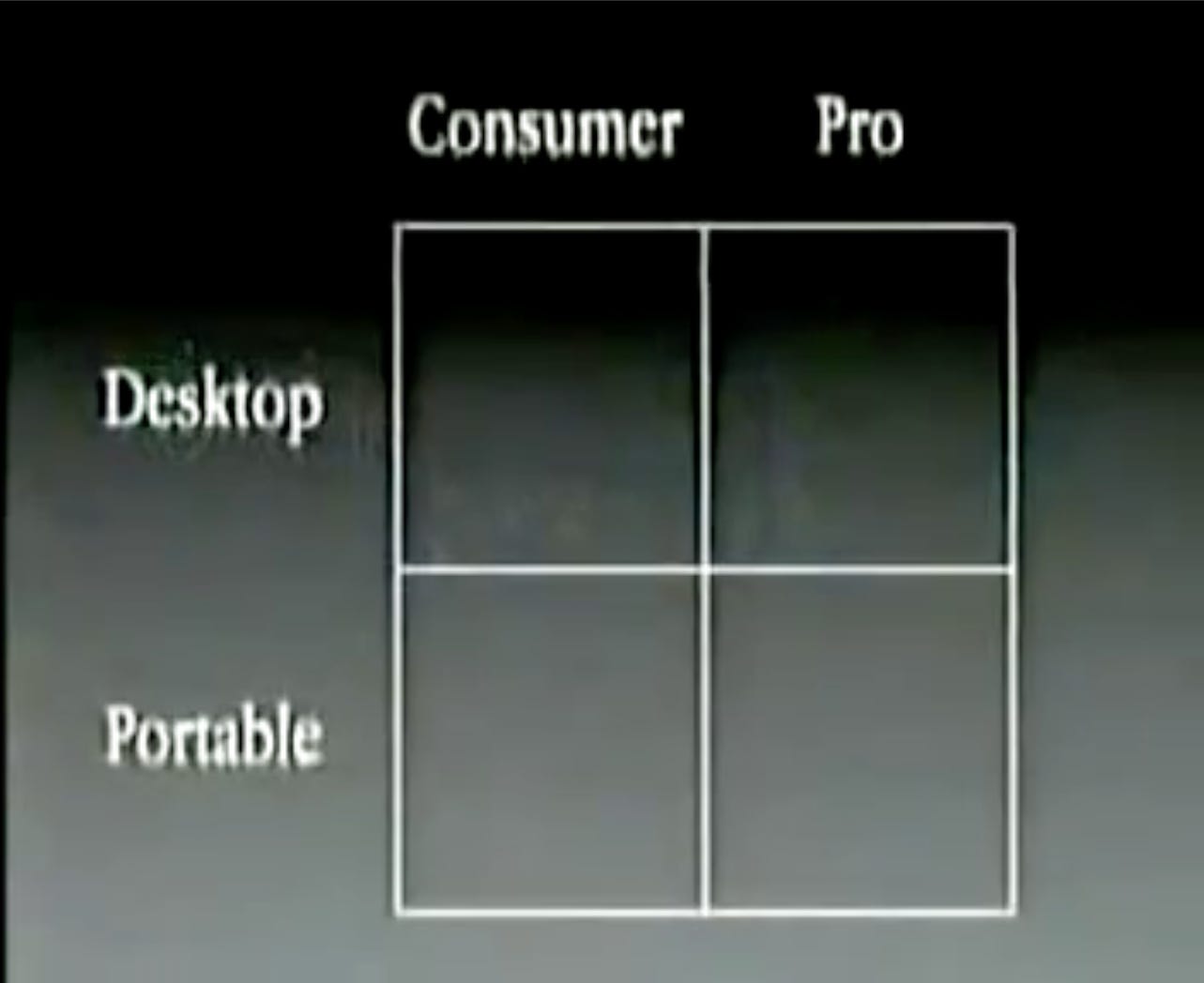
First, Jobs articulated a clear strategy. Apple’s purpose was to build premium, design-driven hardware and software that prioritized simplicity and excellence over chasing market share. Jobs made the strategy concrete with a 2x2 grid: consumer versus professional on one axis, desktop versus portable on the other. Four products. Everything else got cut. That grid served as Apple’s new identity and a ruthless filter for saying no to everything that didn’t fit. He ended the Newton. He killed the clone licensing program. He closed projects that were consuming resources without producing results. The clarity gave every employee, developer, and customer a North Star for what Apple was and was not.
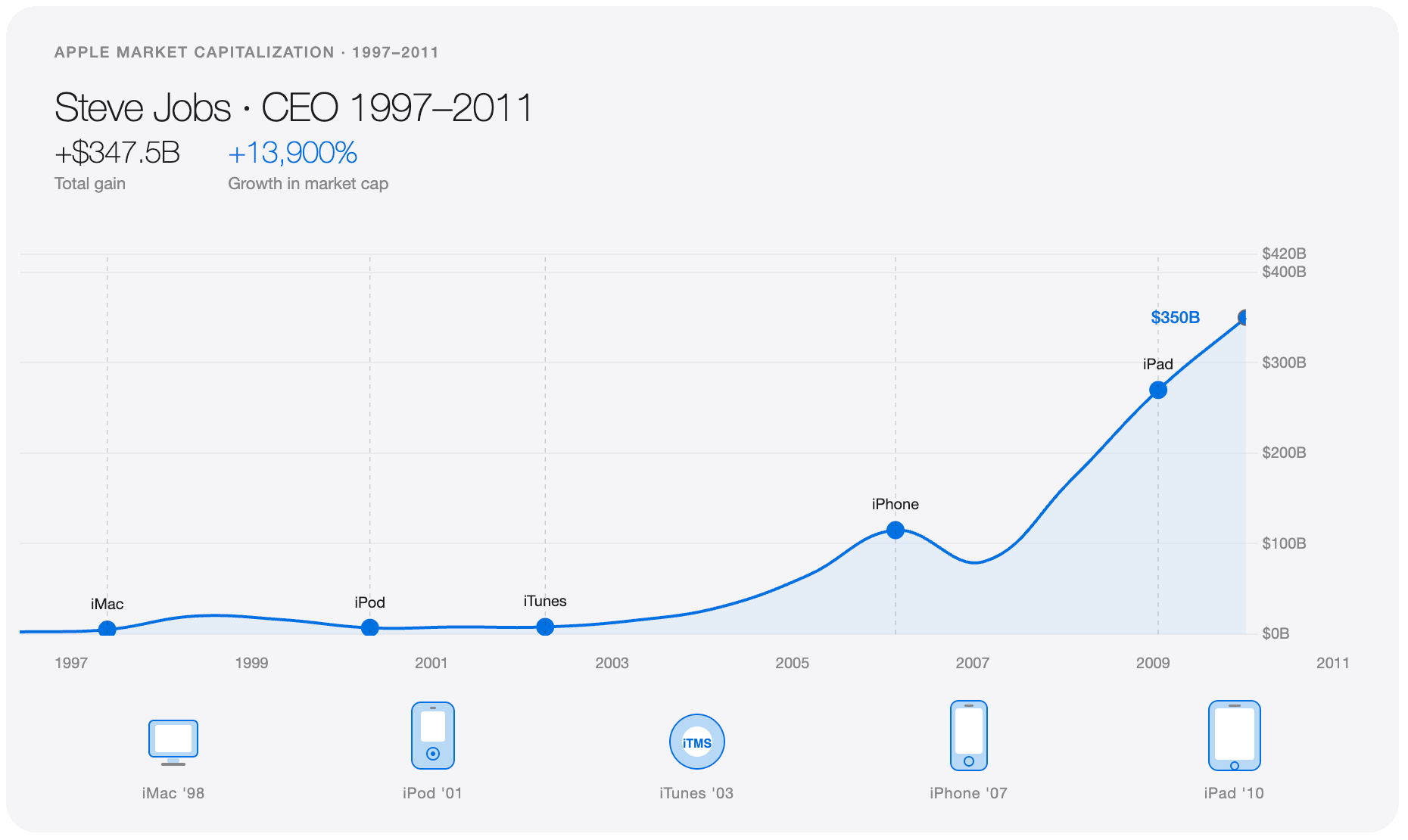
Second, Jobs unleashed innovation through ruthless simplification. With the distractions gone, Apple deployed its best engineers, designers, and talent on its most important projects. The iMac, famous for its revolutionary translucent, and curvy design, launched in 1998 and restored the company’s profitability. The Digital Hub strategy introduced in early 2001 led to the launch of the iPod and iTunes, which dominated the music industry for most of the early 2000s. And the iPhone in 2007 and iPad in 2010 captured the smartphone market and created the tablet category. Apple’s focus on simplification probably unleashed one of the greatest cycles of product innovation in the history of tech.
Third, he built accountability into the organization to drive flawless execution. On the product side, Jobs and Jony Ive obsessed over every detail of the design, from the curves of the iMac to the glass on the iPhone, ensuring that what shipped reflected Apple’s commitment to simplicity and design excellence. No part of the organization was exempt from that standard. On the talent side, Jobs set a simple standard: A players hire A players. Executives who couldn’t keep up were replaced by ones who could. The message was consistent from top to bottom: own the outcome and raise the bar on every iteration.
A company that was weeks from bankruptcy grew its market cap from $2 billion in 1997 to more than $350 billion or more than 150x in value.
Making the shift from peacetime to wartime is hard. Most leaders know what needs to change. Few are willing to do it. The ones who make it work share three traits. They define a strategy clear enough to use as a filter for saying no. They make decisions with speed and conviction rather than waiting for consensus. And they build accountability into the organization so that execution matches the ambition. The shift is never comfortable. But the organizations that successfully make it develop a durable advantage: the ability to win under any conditions.
Thank you to Sydney Schoolfield and Lamia Pardo for reading drafts of this.