

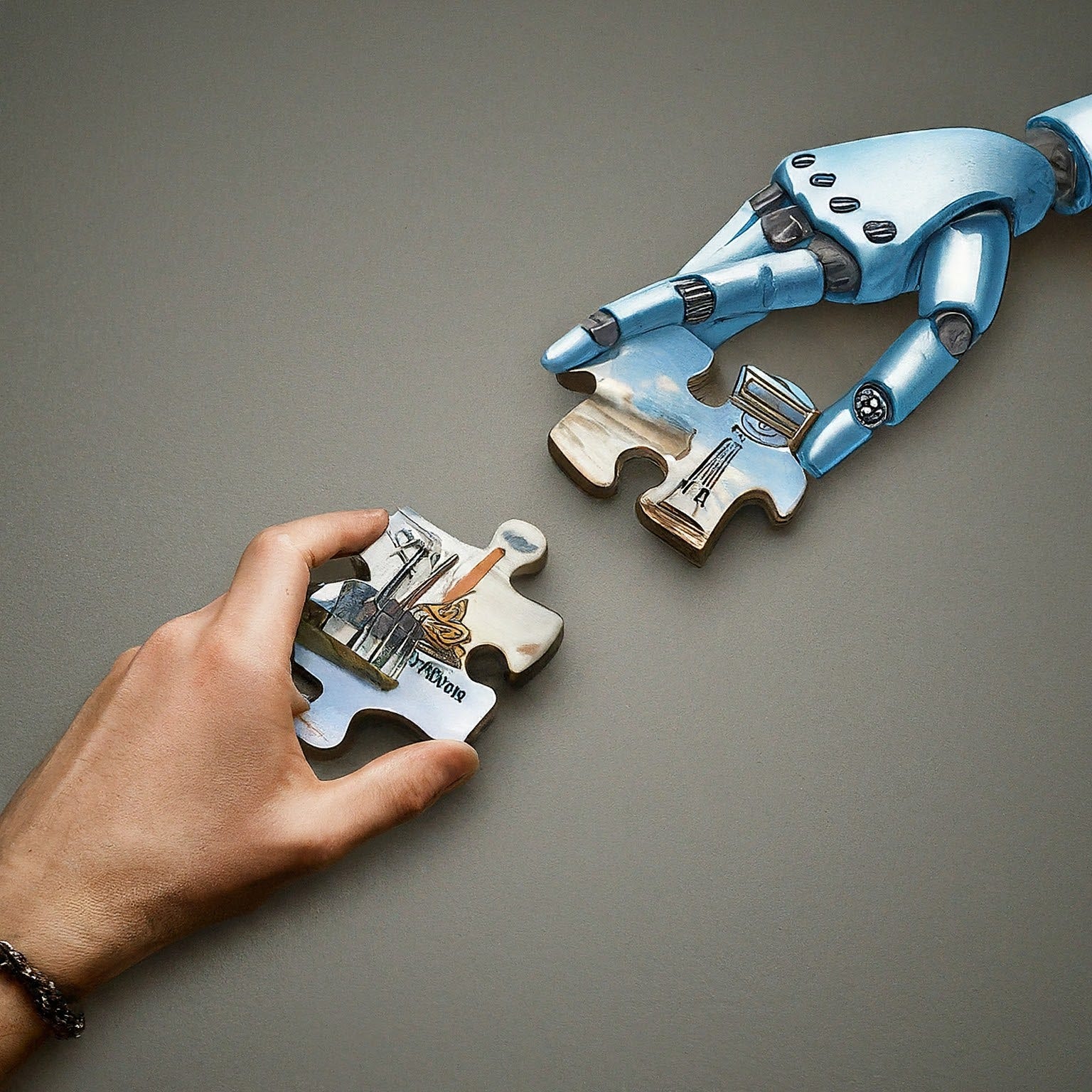
A few months ago I was in a board meeting reviewing a turnaround plan for a business that had stalled for years. The traditional playbook was on the table. Rebuild the sales org. Add 40 to 50 quota-carrying heads. Invest in more marketing staff. Halfway through the presentation, a board member stopped and asked a different question.
“If we had to triple revenue with almost no net new headcount, what would this plan look like?”
That one question flipped the room. Instead of debating how many people to add to each function, the team started rethinking the work itself. Instrumenting every step of the funnel. Embedding AI agents into lead routing and outreach. Using copilots to compress ops and finance workloads. Reserving scarce human capacity for the genuinely hard, high-judgment parts of the business. The plan that emerged wasn’t about rebuilding departments. It was about replacing the headcount reflex with something more powerful: humans and AI working together as the engine of growth.
That moment crystallized something I had been observing across 18 months of conversations with public and large private companies about their AI plans. The organizations pulling ahead aren’t asking “How do we add AI to marketing, finance, or operations?” They’re starting with a simpler, harder question: “What are the few critical problems this company exists to solve?” From there, they design work as systems where humans and AI jointly own those problems. The org chart comes last, not first.
The Shift Most Leaders are Missing
The old question was: how many people do we need? The new question is: what system do we need to build? Most leaders are still asking the first one.
That sounds abstract until you see it play out in a boardroom. Then it’s obvious.
The old model: a problem arrives, you staff a team, the team does the work, you measure output by headcount and activity. The new model: a problem arrives, you design a system, humans and AI agents run the system together, you measure output by outcomes.
Scaling used to mean adding people to departments. Increasingly it means scaling the orchestration of humans, data, and AI agents, and the compute behind them. Headcount becomes one input, not the dominant lever.
Most leaders haven’t internalized this yet. They’re still equating scale with hiring. Every quarter they wait, the gap between them and the companies that have made this shift gets wider and harder to close.
The Ladder of Work
Across the companies I’ve spoken with, a pattern emerges. Call it the ladder of work.
The first rung is where most companies still are: human-only work, with AI as an accessory. People own the job. Tools help occasionally.
The second rung is where most transformation programs are aimed: human plus AI copilot. AI assists but humans still own every decision. It’s a meaningful step. It’s also a rest stop, not the destination.
The third rung is where the leading companies are heading: AI agent plus human copilot. AI runs the default play. Humans supervise, handle edge cases, and refine the system. The human role shifts from doing the work to steering and improving the system that does the work.
The fourth rung, already visible in select domains, is AI autopilot. Humans set objectives, policies, and guardrails. They don’t touch most transactions.
The companies that will win are already designing for the third and fourth rungs. The rest are optimizing a model that’s already being disrupted.
What This Breaks
Once you see the shift clearly, familiar management debates start to look like the wrong conversation.
Job descriptions written around functions rather than problems become obsolete faster than you can update them. Budgeting processes that treat headcount as the primary unit of investment start to misallocate capital. Org charts designed around departments rather than problem-solving systems slow everything down.
The primary design decision is no longer “How many people do we need in this function?” It’s “For this problem, what is the right configuration of humans, data, and AI agents, and how do we scale that system?”
That is a fundamentally different question. Most planning processes aren’t built to ask it.
The Question Worth Asking
The companies I’ve watched making this transition share one trait. They behave as if they are already being forced to operate with minimal headcount. They design for revenue and revenue per employee to grow nonlinearly through systems, automation, and AI, not through linear hiring.
That boardroom moment, where a board member stopped asking “How many people do we need?” and started asking “How do we redesign the work so a small team plus AI can do the work of a much larger one?” is what getting ahead of this shift actually looks like.
It’s not a transformation decision. It’s not even a technology decision. It’s a design decision every company will eventually be forced to make. The only question is whether you make it on your terms or on the market’s.
The question worth asking in your next planning cycle is simple: are you staffing functions or designing systems? The answer will determine where your company stands in five years.